
Skin barrier support · Liquid, not a chew · Added to the food they already eat
One owner's account
Please Stop Trying To Fix Your Dog's Allergies.
I know how insane that sounds when you are watching your dog suffer. But what you are doing right now — the medication, the special food, the endless appointments — is bailing water out of a boat without plugging the hole. Here is what I wish somebody had told me before I spent $4,922 and fourteen months going in circles.
By Margaret Thompson · Hamptons, NY · Updated August 2026 · 4 min read
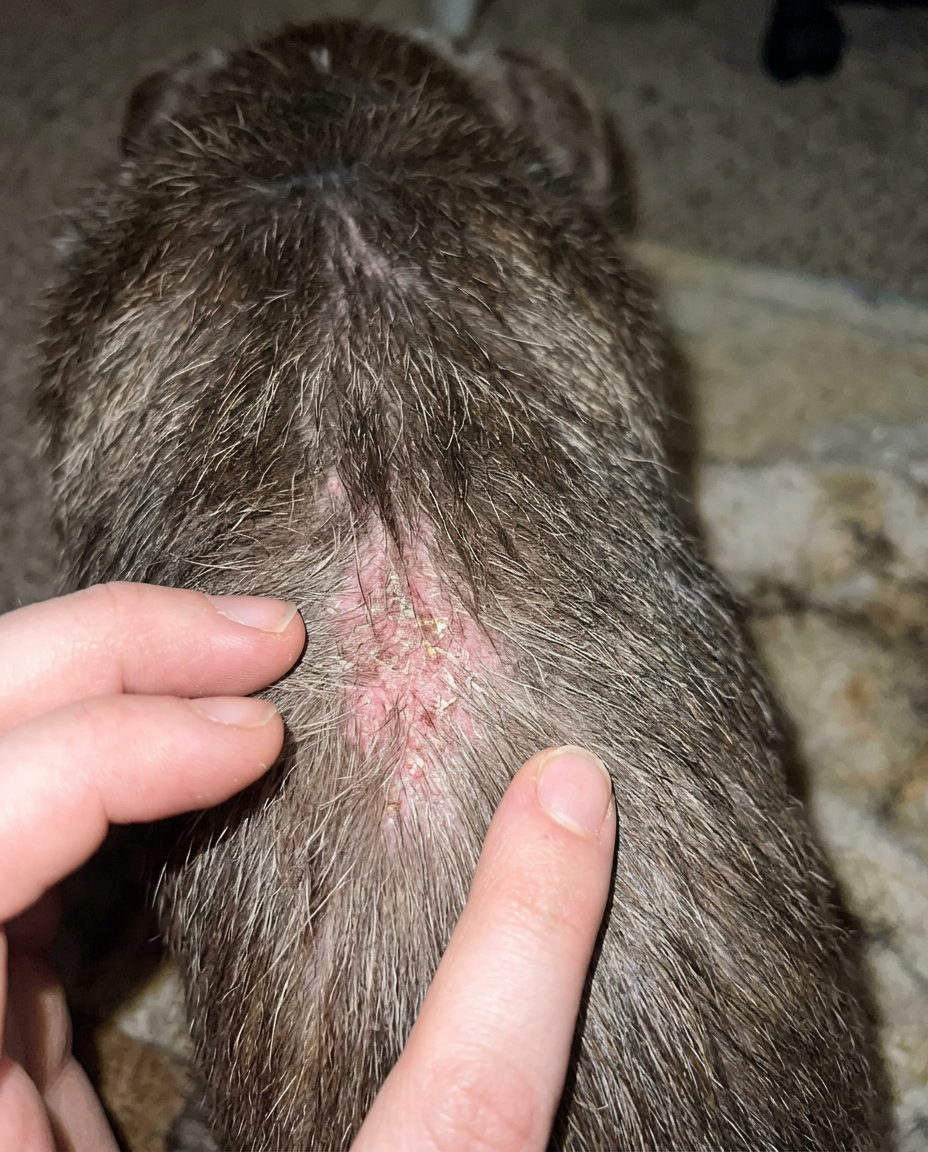
It started small.
Some scratching after she had been outside. A little redness on the belly. Nothing that seemed like anything.
Then it was not small. The scratching became constant. Hot spots appeared overnight. Her ears started smelling like a brewery.
My name is Margaret Thompson. I am 45, I live in Hamptons with my husband John, and Poppy is a seven-year-old doodle who has been the single most expensive mystery of my adult life.
The appointments, in order
First visit. "Let's try Benadryl and see how it goes."
It did not go.
Visit two. "Okay, time for Apoquel. This should help."
It did help. For exactly nineteen days.
I know it was nineteen because I had marked the first good morning on the kitchen calendar with a little star, like an idiot, like somebody who had won something.
Day twenty, the scratching came back at full volume.
Visit three. "We'll bump the dose up."
More money, same three-week fade.
Visit four. "Let's try the monthly injection."
And $165 every few weeks became my normal.
And it worked. Sort of. For a while.
But "a while" kept getting shorter. Six weeks became four weeks became three weeks became "can we come in early, it's back."
Everything else, at the same time
Grain free. Then grain in. Then fish based. Then a novel protein that cost more per pound than my own groceries.
Allergy testing that came back saying she is sensitive to essentially everything that exists outdoors.
Probiotics. Fish oil. Coconut oil rubbed directly into the skin. Oatmeal baths every three days on a dog who hates water.
Every single one of them worked for about two weeks.
Then straight back to the start.
$880
$1,815
But honestly, the money was not the worst part. The worst part was the cycle.
New treatment → improvement → "finally, we've got it" → symptoms return → flat devastation → repeat.
Over and over and over. And after four or five turns of that you stop letting yourself feel the good part, because the good part is what makes the next one hurt.
I started to genuinely believe this was just life now. That some dogs are simply like this. That we would be managing it forever and that was the deal.
The day it changed was not dramatic
It was a Tuesday afternoon. I was sitting at the kitchen table looking at another invoice for another injection.
And I just went flat. Not crying. Not angry. Empty.
And I opened my laptop and searched something I had genuinely never thought to search in fourteen months.
Not best treatment for dog allergies. Not what works for itchy dogs.
"Why does my dog's itch treatment keep wearing off?"
I wanted the why. Nobody had ever given me a why. Every appointment had given me a what.
Third result down was an article by a veterinary dermatologist, and the opening paragraph made me sit up straight:
The paragraph I screenshotted
"Many itchy dogs aren't becoming more allergic over time. Their skin is becoming less able to keep allergens out. Most standard treatments quiet the immune response, which brings real relief, but they do nothing to support the skin barrier underneath."
I read it again. Then a third time. Because for the first time in fourteen months somebody was describing the thing I had actually been living, instead of handing me the next thing to buy.
Here is what that article, and then a long conversation with a vet in Fair Oaks who actually had time for me, explained.
The question that ended fourteen months of guessing
The vet in did not write anything down at first. She asked me two questions, and I could not answer the second one.
"Where does she itch?"
Paws. Belly. Armpits. Ears, I said.
"And where doesn't she?"
I had to think about it.
"Along her back," she said. "Shoulders, spine, the top of the hips. Has that ever been a problem?"
Never. Not one hot spot there in six years.
"Pollen and dust land on her back more than anywhere else. If this were only about what's in the air, her back should be the worst. So what's different about the places she itches?"
The skin is thinner there. The fur is sparser.
Try this before you scroll
Picture where your dog itches most. Now picture where they never itch.
For most dogs it's the same map: paws, belly, armpits, ears, and almost never the middle of the back.
The itch tends to follow the thinnest, most exposed skin. That pattern is a clue, and it points straight at the barrier.
What the skin barrier does
Healthy skin is a wall. Its job is to keep the outside world (pollen, dust, grass, microbes) on the outside, where it's harmless.
Collagen is one of the main structural proteins that gives that wall its strength. If skin cells are the bricks, collagen is a big part of the framework holding them together.
Dogs, like us, make less collagen as they age. Less structure means a weaker wall, and the thinnest areas (paws, belly, ears) feel it first.
A strong barrier
Allergens stay on the surface. The immune system never meets them, so there's nothing to react to.
A worn-down barrier
Gaps open up. The same allergens reach living tissue, and the immune system responds, exactly as it's designed to.
That attack is the itch. The chewing. The hot spots. The ear infections every spring. The belly rash. The yeast. All of it — one wall failing in different places at different speeds.
Poppy's immune system was never broken. It was doing its job through a wall with holes in it.
And then the part that made me feel sick
I asked why the Apoquel kept stopping working.
She said: "It never stopped working. It does exactly what it always did."
Apoquel, steroids and Cytopoint all act on the reaction. They are genuinely good at that — that is why those first nineteen days felt like a miracle. But while the reaction is being muted, absolutely nothing is happening to the wall underneath. It keeps thinning. Quietly. Behind the relief.
So more gets through every month. There is more for the immune system to answer. The same dose is doing more work than it was last quarter.
The medication never lost its power. It is losing a race against a wall that is still collapsing.
Which is why you raise the dose, and it holds for a bit, and the wall gets worse. So you add the injection, and it holds for a bit, and the wall gets worse. And the injections move from six weeks to five to four.
More fire extinguishers. Same growing hole. They will never catch up, because a fire extinguisher is not a wall.
Fourteen months. Four appointments. $4,922. And every single thing on that ledger was aimed at either the surface of the dog or the reaction of the dog.
Not one dollar of it was aimed at the wall.
"Fine. But I already tried collagen."
That was my exact response, and I said it almost rudely, because there was a tub of collagen chews in my cupboard right then that had done absolutely nothing for five months.
This is the bit almost nobody knows, and it is the reason most people reading this have already written collagen off.
Collagen in a chew or a powder is a large, whole, intact protein. It has to survive the stomach, and most of it does not — it gets broken apart and burned as fuel long before it reaches the cells that build skin.
And anything solid was heat-processed to make it solid. Heat damages protein. You cannot un-cook an egg.
You never tested collagen. You tested a delivery method, and the delivery method failed.
| Approach | Works on | The catch |
|---|---|---|
| Shampoos, wipes, sprays | The surface | Back within days |
| Apoquel, steroids, Cytopoint | The reaction | Fades as the reaction returns |
| Diet changes | Food triggers, if there are any | Barrier unchanged either way |
| Chews and powders | Mostly a snack | Heat-processed, harder to absorb |
| Hydrolyzed liquid collagen | The barrier itself | The barrier stays rebuilt |
Every row in that table has genuinely satisfied customers. None of them are frauds. They answer different questions. And most of us spend two or three years buying exclusively from the top two rows and then decide our dog is a lost cause.
Which one, though
I asked her that too, because there are forty of these on Amazon and they all have a happy dog on the front.
She told me what to actually look at, and it is four things:
- Form
- Liquid, not a chew or a powder. If it is solid, it was heated, and the protein was damaged before it ever left the factory.
- Hydrolyzed
- Pre-broken into fragments small enough to cross the gut lining. The word has to be on the label. "Collagen" alone means nothing.
- Label
- Marine, not chicken or beef — a good share of itchy dogs are already reacting to exactly those two proteins, which is a spectacular own goal in a skin supplement.
- Daily use
- Something you can actually give every single day for three months without a fight. A pump onto food they already eat beats the best formula on earth that your dog spits out.
I went with Canbloom Premium Liquid Collagen. It's liquid and hydrolyzed, and it goes right on top of her regular dinner. There are no pills to hide and no fight.
The part that made me comfortable trying it: it's a food supplement, not a replacement for her treatment. Stay on whatever your dog is on. Just add it, and let the wall rebuild underneath while the medication keeps doing its job on top.
Canbloom Premium Liquid Collagen
Hydrolyzed liquid collagen that supports your dog's skin and coat from the inside. Add it to the food they already eat, alongside whatever routine your vet recommends.
$24.95
$60.00
Liquid, not a chew · Easy daily routine · Secure checkout
What the next three months actually looked like
I am going to be honest about this timeline because I nearly quit twice, and because everybody who quits quits in the same two weeks.
- Week 1
Nothing. Absolutely nothing. The wall is being supplied, not yet rebuilt.
- Week 2
Still nothing, and Poppy seemed slightly worse for about four days. I was ready to write the whole thing off. This is the week most people stop.
- Week 3
The first thing I noticed: the evening paw-licking got shorter. Still there, just shorter.
- Week 4
Fewer 3am thumps. I know because I was lying awake counting them.
- Week 6
Her ears looked clean two mornings in a row. Then a third. I made my partner come and look.
- Week 8
A hot spot on her belly finally healed and stayed healed instead of reopening.
- Week 10
The reddish-brown lick stains on her front paws started growing out.
- Week 12
The thin patch near her tail filled in. Coat is the last thing to change, because her body was busy with everything else first.
Somewhere in month three I tapered the Apoquel with my vet — half dose for two weeks, quarter for two weeks, then nothing. No flare. Then we stretched the Cytopoint from four weeks to six, then eight, then stopped booking it.
But that is not the part I actually want to tell you
It wasn't really the coat. It wasn't even the scratching.
Somewhere around week seven Poppy started asking to go out again. Standing by the door doing the specific noise she does. Bringing me things. Putting her chin on my knee while I worked, which she had not done in a year.
I had spent a year telling people my dog was slowing down because of her age.
She wasn't getting old. She had been uncomfortable every single day, and I had mistaken it for her personality.
That's the part that still gets me, and it's why I wanted to share all of this.
Two people noticed before I said a word
At week six our groomer ran her hands down Biscuit's sides and asked if we'd changed her food, because her coat felt different.
I hadn't told anyone. After so many false starts I had stopped announcing new attempts.
At the twelve-week check, the vet looked at her skin, her ears and between her toes, and said it was the calmest she had seen her.
When I mentioned the barrier article, she nodded:
"We spend most of our time managing flare-ups. Supporting the skin itself deserves more attention than it gets."
She's a great vet. The system just tends to focus on the urgent problem in front of it. That's how you can do everything right and still feel stuck.
The math that convinced me
Sixteen months of chasing the itch: $4,400.
A bottle of Canbloom Premium Liquid Collagen: $24.95.
It's not a replacement for good veterinary care. It was simply the first thing in sixteen months aimed at the skin itself instead of the symptoms on top of it.
A friend who fosters dogs put it in a way I haven't forgotten:
"Some things you pay for every month, forever. Some things you build up over time. Know which one you're buying."
Who this probably isn't for
I'd rather you keep your money than buy this for the wrong dog:
If your dog is very young and the itching just started, talk to your vet first. It may be something simpler.
If it came on suddenly, over a few days, then fleas, mites, an infection or a contact reaction are far more likely. See your vet now. Don't wait on a supplement.
If it's one isolated patch that never moves or spreads, get it looked at properly.
If you need results this week, this isn't it. Skin support takes weeks of consistent daily use, and there's no shortcut.
Who's left is the dog most people reading this have. Middle-aged or older. Itchy in the same places for months or longer. Worst on the paws, belly and ears, fine along the back. On a routine that seems to work a little less well every season.
Give it twelve honest weeks.
Skin support doesn't happen overnight. Add it to their dinner every day, keep up the plan your vet recommends, and judge it at week twelve, not week two.
See the offerLiquid, not a chew · Added to food they already eat · Secure checkout
P.S. In sixteen months, not one person suggested looking at Biscuit's skin barrier. Everyone had the next thing to try, and nobody explained why the last one faded. I don't think anyone was hiding anything. It's just not the question most of us are taught to ask. I hope this saves you some of the time it cost me.
P.P.S. If your dog is only just starting to scratch, you're in the best position of anyone reading this. It's far easier to support skin early than to play catch-up after a year of flare-ups.
This story is a composite based on experiences shared by dog owners and is for illustration only. These statements have not been evaluated by the Food and Drug Administration. This product is not intended to diagnose, treat, cure, or prevent any disease. Individual results vary. Canbloom Premium Liquid Collagen is a food supplement and does not replace veterinary care. Always consult your veterinarian before starting, changing or stopping any medication.